7 Counter-Intuitive Pickleball Secrets to Level Up Your Game (Without Getting Smashed)
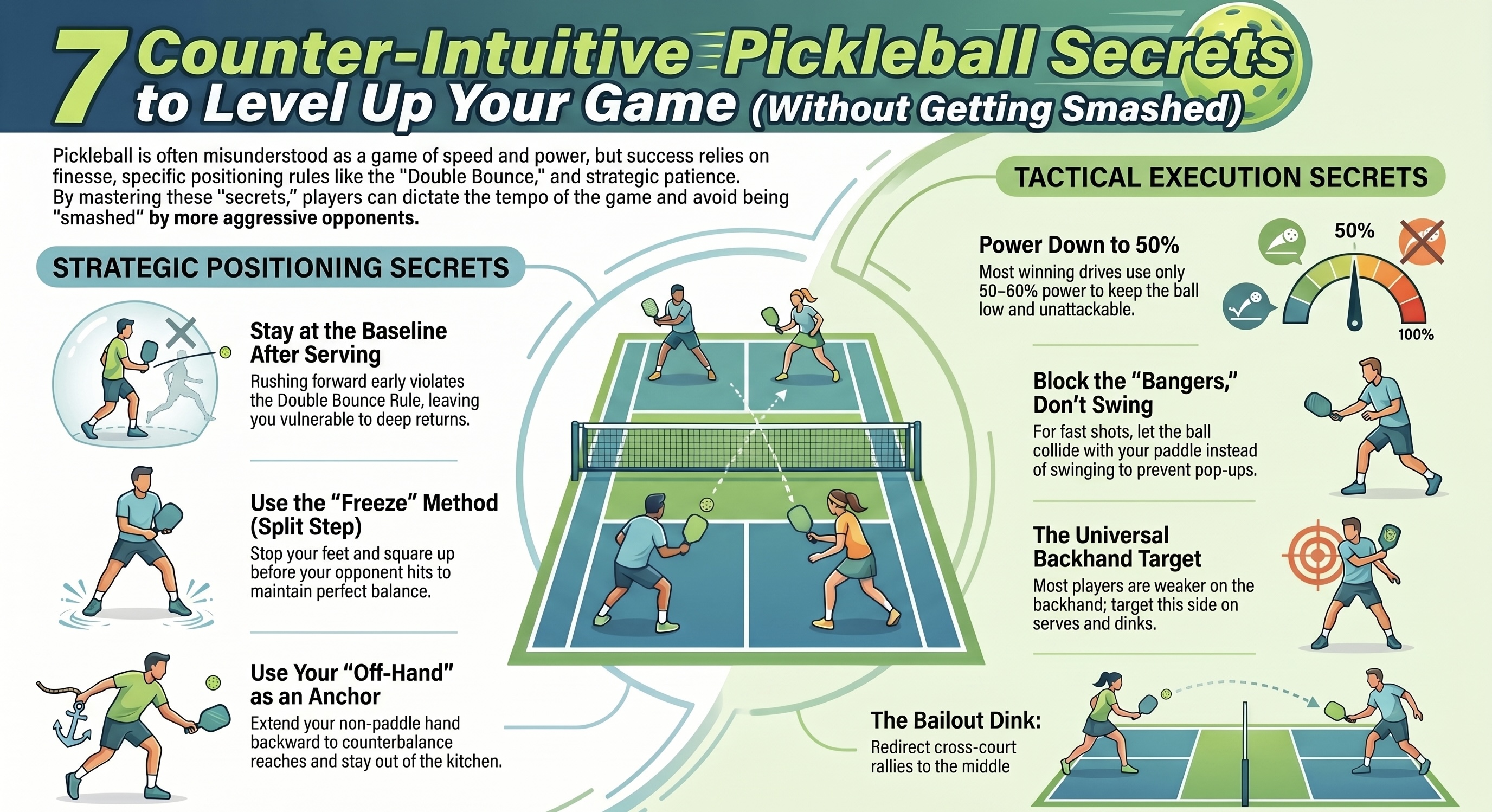
Pickleball has exploded into the fastest-growing sport in the U.S., but for many, that growth comes with a steep learning curve. There is a specific kind of frustration in showing up to the court only to find yourself constantly "slammed at" or left confused by the flurry of shots. To move past the "beginner" label, you have to stop reacting and start orchestrating. This guide is your coaching session to help you trade raw power for high-level strategy.
1. The "No Man’s Land" Death Trap
In my coaching sessions, the first thing I look at is positioning. The area between the baseline and the kitchen line is "No Man's Land," and standing there is a tactical suicide mission. This zone leaves you vulnerable to shots aimed at your feet or extreme cross-court dinks.
To understand why we stay back initially, you must master the Two-Bounce Rule: the ball must bounce once on the serve and once on the return before anyone can volley. Beginners often scoot up too early after serving, only to get a deep return at their feet. If you are caught in the transition zone while moving forward, you must execute a Split Step. This means stopping your momentum and jumping into a wide, athletic stance right as your opponent makes contact with the ball.
Attempting to return these shots are difficult by itself, but even harder because you're typically running at the same time. Returning a shot to your feet while running is borderline impossible.
2. The "Miss Rule": Why Failing a Few Serves is Actually a Good Sign
Most beginners play a "just get it in" game, but a safe, floaty serve is just a gift for your opponent. I tell my players you should be missing two to three serves deep per match. If you aren't missing occasionally, you aren't being aggressive enough with your depth.
When you go for these aggressive serves, remember the 10-second rule: if you drop the ball or swing and miss completely, it isn't a fault yet. You have 10 seconds from the time the score is called to pick that ball up and re-serve. Use that time to compose yourself and target your opponent's "inside foot." This creates immediate confusion, forcing them to decide between a backhand or forehand return in a split second.
3. Your "Off-Hand" is Your Secret Balance Weapon
High-performance play starts with the Continental Grip, also known as the "shake hands" grip. When you hold the paddle, your index knuckle and thumb should form a "V" shape on the handle. This grip is the foundation of your balance, but your non-paddle hand is what keeps you upright.
As your paddle hand moves forward to reach for a volley, your off-hand should move backward as a counterbalance. This keeps your weight centered and prevents you from "tumbling" into the kitchen. As one pro coach noted:
Before I didn't know my left hand could only hold my watch, but I found a second use for my hand... when my off-hand goes back and counterbalances, my balance stays centered and you will not have forward momentum.
4. The 60% Power Paradox: Why Less is More
One of the hardest habits to break is the urge to smash the ball at 100% power. In reality, red-lining your power leads to out-of-bounds errors or easy blocks by advanced players. Use the "60% Power Rule" for your drives to maintain control and keep the ball low at your opponent's feet.
This brings us to the "Third Shot Decision." You should Drive if the return is short or if your opponent is still running to the net. However, you should Drop on deep returns or when you are under pressure. A soft drop shot provides LOFT (Lots Of Freaking Time), giving you the window you need to move forward and establish your position at the kitchen. As the pros say:
Winning in pickleball is about consistency, persistence, and strategy, not as much about trickery and cunning.
5. The "One-Foot" Strategy for Kitchen Safety
The "kitchen" (non-volley zone) is a semicircle of strategy and danger. To avoid foot faults, never enter the kitchen with both feet if you can help it. If you step in with only one foot to hit a ball that has bounced, your brain maintains a physical "anchor" to the legal zone.
When you put both feet in, you lose track of the line. By keeping one foot back, your body naturally knows exactly how to reset. To give yourself a buffer, always stand 3–4 inches behind the kitchen line. This "safety gap" allows you to pivot and rotate without your toes sliding into the zone and costing you the point.
6. The "Banana and Tree Bark" Rule for Gear
I see many players spend more time shopping for paddles than practicing their dinks. While gear matters, it shouldn't be an excuse for poor form. Remember the First Commandment of Pickleball Paddle Choice:
Thou shalt not blame thy pickleball mistakes on thy pickleball instrument.
Unless your paddle is a "nightmarish amalgamation of bananas and tree bark," focus on your skill first. When you do upgrade, look for a paddle in the 60-150 range. Don't guess on weight—use a kitchen scale or a site like pickleballcentral.com to find your "sweet spot." You want it heavy enough for power but light enough to avoid "pickleball elbow" or arm fatigue.
7. Safety First: Why Your Shoes Matter More Than Your Swing
Pickleball is a game of violent lateral movements. This puts massive stress on your ligaments and tendons, especially in the ankles and knees. You need a shoe with appropriate cushion and a height that supports your ankles during side-to-side shuffles.
Safety also means checking your ego. New players should avoid competing against highly advanced players too early. The increased pace and intensity of high-level games can lead to muscle strains if your body isn't yet conditioned for that level of recovery. If you feel persistent pain, stop immediately—playing through it only guarantees a longer time off the court.
Conclusion: From Reaching to Reacting
Moving from a beginner to a master of the court takes patience and the right "tribe" of players to challenge you. Improvement isn't measured by how hard you can hit, but by how well you can control the tempo of a rally. As you head out for your next session, ask yourself: "Are you playing to just hit the ball, or are you playing to control the court?"

Why Your Pickleball Hobby Might Be Hitting Your Elbow Harder Than Tennis Ever Did


