Why Your Pickleball Hobby Might Be Hitting Your Elbow Harder Than Tennis Ever Did
1. Introduction: The Rising Cost of the Court
It’s a hollow plastic ball and a lightweight paddle, yet sports medicine clinics are filling up with pickleball players faster than the courts themselves. While the game is often marketed as a gentler alternative to tennis, many players are discovering a painful reality: their "lighter" hobby is actually harder on their joints.
The central mystery lies in the math of the game. How can a sport with a smaller court and a lighter ball cause more significant elbow issues than its traditional counterpart? To solve this, we have to look past the social fun and dive into the specific biomechanics of the "pickleball pop."
2. It’s Not the Paddle: The Myth of Equipment Weight
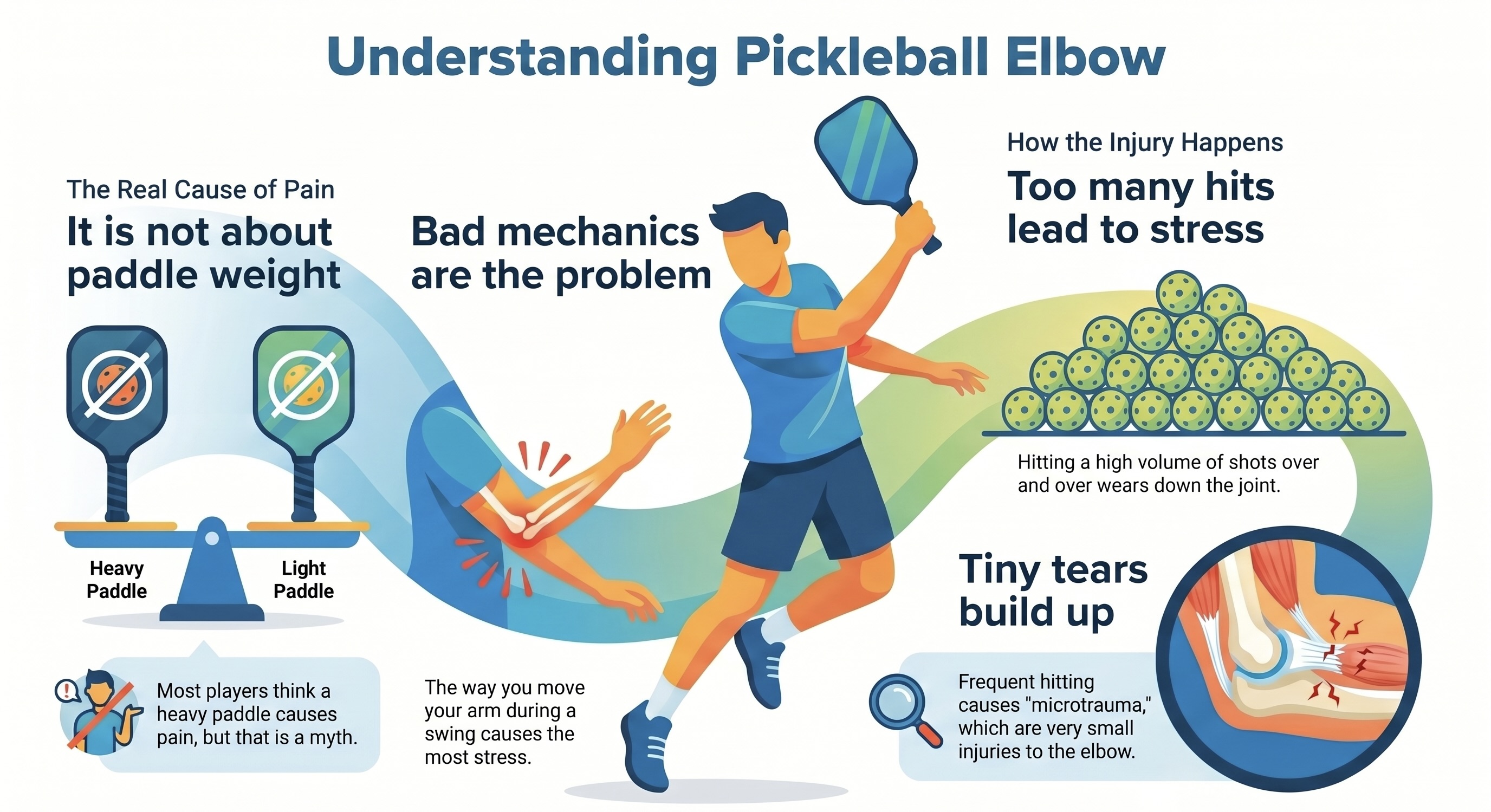
When that nagging ache begins, most players immediately blame their gear. They assume that switching to a lighter paddle will take the pressure off their arm.
The biomechanical reality, however, is that paddle weight is rarely the primary culprit. It is a common distraction from the more important realization that how you hit the ball matters far more than what you hit it with.
Focusing on equipment often leads players to ignore the actual movements causing the damage. The secret isn't in the shop; it's in your swing.
3. The Hidden Culprit: High-Volume Mechanics
The "aha!" moment for most players comes when they compare the "levers" used in both sports. Tennis relies on a "long-lever" stroke, where the power comes from the legs, hips, and a full, fluid arm extension. Pickleball is a game of "short-levers," dominated by quick, flicking motions and rapid elbow pops to handle the fast-paced kitchen volleys.
While a tennis ball is heavier, the frequency of impact in pickleball is the hidden variable. Because the court is smaller and the pace is faster, you are simply hitting the ball more often. In a typical match, you might perform hundreds of rapid-fire strokes with very little rest between them.
"It's not the paddle weight—it's the mechanics."
This combination of short, jerky movements and high-volume hitting creates a perfect storm. The elbow is forced to absorb constant, rapid impacts without the benefit of the full-body weight transfer used in tennis.
4. The Physical Toll: Understanding Severe Microtrauma
This constant repetition leads to a specific biological breakdown. Each time you "flick" a shot, you are creating tiny, invisible tears in the tendons of the elbow joint. In sports science, we call this severe microtrauma.
Think of it like bending a paperclip. If you bend it once, it stays strong. If you wiggle it back and forth hundreds of times in a row, the metal weakens and eventually snaps. Because pickleball is so fast, your tendons don't have time to recover between hits, leading to chronic inflammation and pain.
Even if a single hit doesn't hurt, the cumulative effect of this severe microtrauma is what makes "Pickleball Elbow" so serious. It is a slow-motion injury that builds up over thousands of repetitions until the tissue can no longer repair itself.
5. Conclusion: Moving Forward on the Court
Staying active shouldn't have to come at the cost of your joint health. By recognizing that high-volume hitting and short-stroke mechanics are the true drivers of injury, you can begin to adjust your game. Protecting your elbow requires moving away from "all-wrist" shots and learning to use your core and shoulders to drive the ball.
As you head out for your next match, ask yourself: Am I playing with my whole body, or am I letting the high-speed nature of the game force me into damaging habits? A few mechanical changes today could ensure you stay on the court for years to come.

7 Counter-Intuitive Pickleball Secrets to Level Up Your Game (Without Getting Smashed)


