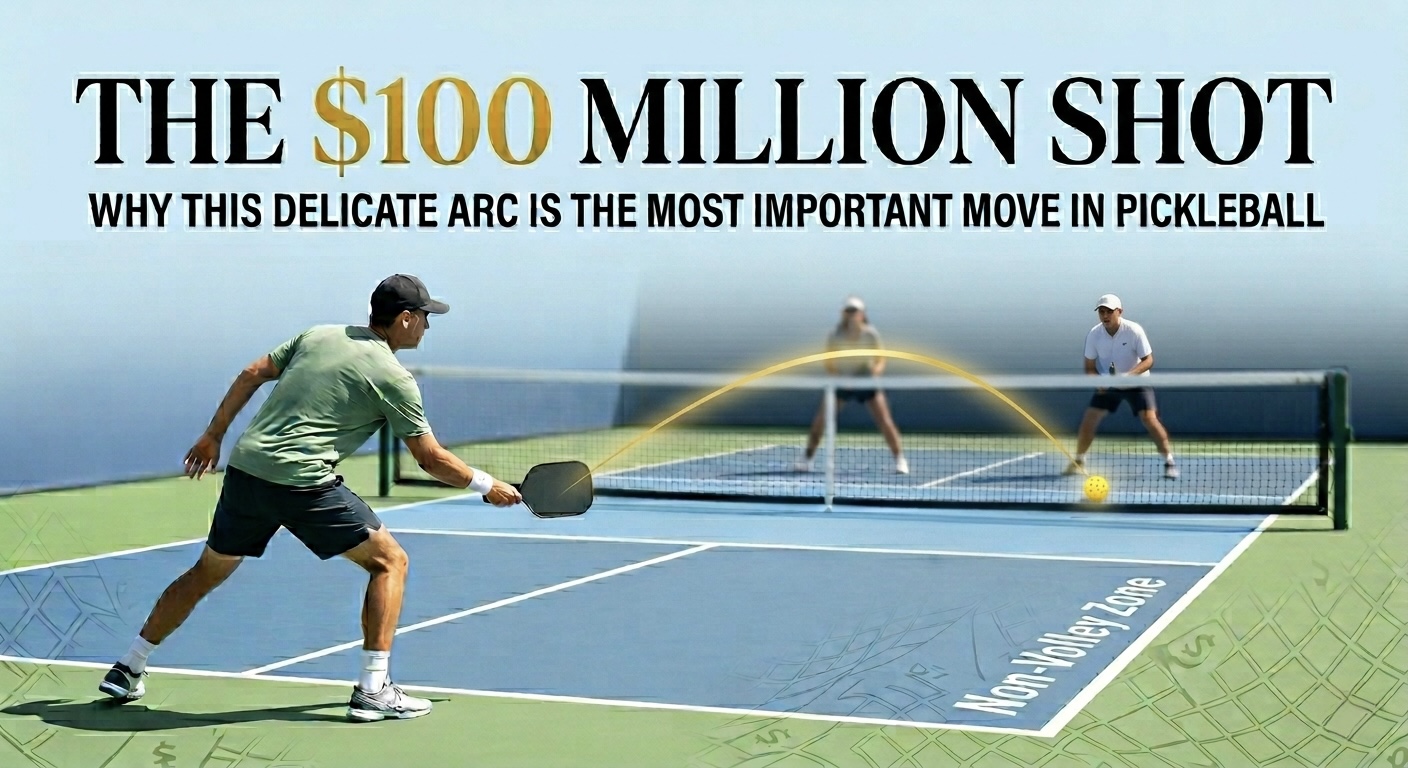
The $100 Million Shot: Why This Delicate Arc Is the Most Important Move in Pickleball
The Hook: Neutralizing the Baseline Trap
Across the country, the rhythmic pop of the paddle has become the soundtrack of a modern sports revolution. Yet, for many players, the excitement of the game quickly turns to a specific kind of tactical claustrophobia. You serve, the opponent returns deep, and suddenly you’re pinned at the baseline like a boxer against the ropes. You’re watching the opposing team dance at the net, controlling the kitchen, while you’re stuck 22 feet away with no clear path forward.
This frustration stems from the fundamental geometry of the sport. Because of the double-bounce rule, the serving team is naturally disadvantaged, forced to stay back while the returning team crashes the net. To break this stalemate and neutralize the "bangers" at the line, you need more than just power. You need the "Third Shot Drop"— the definitive tactical solution that transforms a defensive liability into a professional-grade offensive.
The Money Shot: Why It’s Worth $100 Million
In the high-stakes world of professional tournaments and elite club play, this move is treated with a level of reverence usually reserved for a game-winning touchdown. It has earned a title that reflects its immense strategic value:
"Third Shot Drop: The $100 Million Pickleball Shot"
This isn't about a literal price tag; it’s a journalistic valuation of the shot’s utility in the "money" rounds. For a strategist, the Third Shot Drop is the ultimate high-yield investment. It is the single move that separates the recreational "ping-pong" style of play from the sophisticated, chess-like maneuvers of the pros. When you can execute this shot, you aren't just hitting a ball; you are buying your way into the point’s winning percentage.
Mastering the Arc: Why Softness is the Ultimate Power
The Third Shot Drop is defined by a "delicate arc," a description that belies the brutal difficulty of its execution. In a sport dominated by fast volleys and overhead slams, this is widely considered the hardest move to master because it requires you to make gravity your primary ally rather than your strength.
The technical challenge lies in the fine motor control required to lift the ball just high enough to clear the net, but with enough "touch" to ensure it begins its descent immediately afterward. You are essentially trying to land a marble into a bucket from twenty feet away while an opponent is screaming for you to miss.
In the heat of a match, the mental pressure often causes players to "tense up," leading to a shot that is either too long (an easy "put-away" for the opponent) or too short (hitting the net). Mastering this arc requires a paradoxical blend of total physical relaxation and intense mental focus, making it the ultimate test of a player's composure under fire.
The Bridge: Crossing "No Man's Land" to the Kitchen
The primary tactical function of the Third Shot Drop is to act as a bridge across the most dangerous part of the court: the transition zone, often referred to by pros as "No Man's Land." Without a soft drop, attempting to move toward the net is a suicide mission, as opponents will simply hammer the ball at your feet while you are caught in mid-motion.
This delicate arc "unlocks" your safe entry into the non-volley zone, or the "kitchen." By landing the ball softly at the feet of your opponents within that zone, you force them to hit the ball upward to clear the net. This upward trajectory is the green light you’ve been waiting for; it robs them of their ability to attack and creates the necessary window for you and your partner to glide forward safely.
The "entry" is the operative word here. The Third Shot Drop isn't necessarily a winner on its own, but it is the key that opens the gate. It neutralizes the opponent's height advantage and resets the point, allowing you to establish your position at the kitchen line where the real battle for the point begins.
Conclusion: The Path to Million-Dollar Results
Mastering the Third Shot Drop fundamentally alters the geometry of a pickleball match. It turns a chaotic game of survival into a calculated strategic pursuit, allowing you to dictate the tempo rather than merely reacting to your opponent's power. By refining this one "delicate arc," you stop playing the game on your heels and start playing it on your terms.
The path to the podium is paved with thousands of these soft, precise drops. The question for every aspiring competitor remains: Are you willing to put in the hours to master the hardest move in the game to achieve "million-dollar" results on the court?

7 Counter-Intuitive Pickleball Secrets to Level Up Your Game (Without Getting Smashed)


