Boeing Floorboards to Rocket Launchers: The Gritty Science of Your Pickleball Paddle
The Paradox of the Modern Paddle
It usually starts with a borrowed paddle that feels like a glorified cutting board. Three games later, you’re hopelessly addicted, scouring the internet for your first real upgrade, only to be met by a wall of marketing noise. You’re staring at prices ranging from $20 to $330 and a dizzying array of buzzwords: "thermoformed," "T700 raw carbon," and "swing weight."
Welcome to the "Goldilocks problem" of pickleball gear. Here is the central paradox: if you were to saw 99% of these paddles in half, the guts would look nearly identical. Yet, on the court, one feels like a plush pillow while another hits like a rocket launcher. To find the gear that's "just right," we have to cut through the fluff and deconstruct the physics and the surprising industrial history of the paddle.
The "Airplane Scrap" Origin Story
The high-tech evolution of pickleball wasn't a slow burn; it was a sudden heist of aerospace engineering. In 1984, an industrial engineer at Boeing named Arlon Parto grew tired of the heavy, loud plywood paddles that dominated the era. Having access to the scrap bin at Boeing, he experimented with lightweight structural panels used in aircraft flooring and walls—specifically, honeycomb cores sandwiched between fiberglass.
Parto’s "industrial leftover" experiment changed the game overnight. It was light, incredibly strong, and rigid.
"That honeycomb structure is still the DNA of almost every paddle sold today."
There is a delicious irony in the fact that while you’re paying $250 for a "Gen 3" paddle today, the core technology is essentially the same stuff people walked on in a 1980s jetliner.
The Core Thickness Paradox: Why Thicker Isn't More Powerful
When you’re browsing the spec sheets, the most critical number is often the one people ignore: core thickness. While it seems intuitive that a thicker paddle would be "meatier" and thus more powerful, the physics of energy return says the exact opposite.
Thicker Cores (16mm to 20mm) Equal Control; Thinner Cores (13mm to 14mm) Equal Pop.
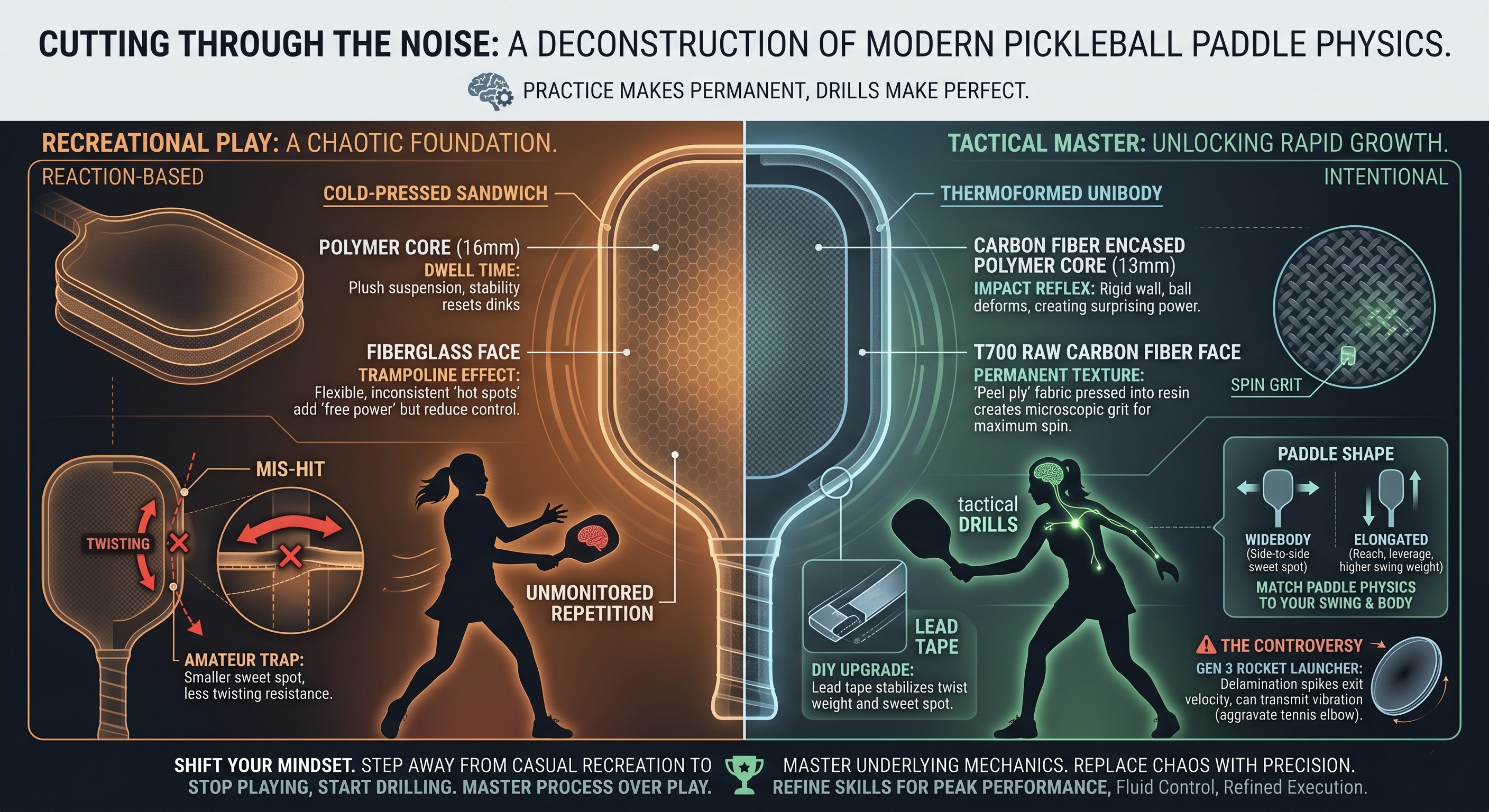
Think of the core as a car's suspension. A 16mm core (or the ultra-plush 20mm variants) acts as a shock absorber. When the ball strikes, it sinks into the paddle for a fraction of a second longer—we call this "dwell time"—which stabilizes the ball and allows you to "reset" a hard smash softly into the kitchen.
Conversely, a 13mm core is stiffer. Because there is less material to cushion the impact, the ball rebounds instantly. While this provides massive "pop" for aggressive drives, the tradeoff is a smaller sweet spot. Miss the center on a thin paddle, and it will twist in your hand like a live wire.
And then there's the sound. Most modern paddles use Polypropylene (Polymer), a soft plastic that feels pillowy and quiet. But if you hear someone hitting a ball that sounds like a gunshot, they’re likely swinging a Nomex core. Nomex is a cardboard-like material dipped in resin; it’s incredibly hard and fast, but it’s fallen out of favor because it’s nearly impossible to hit a delicate drop shot with something that feels like a stone.
Surface Secrets: T700 Carbon and the "Peel Ply" Advantage
If the core is the engine, the surface material is the tires. This is what dictates your spin and "dwell time."
- Fiberglass: Found on budget paddles, fiberglass is flexible and creates a "trampoline effect." It’s great for beginners who need "free power," but it’s unpredictable. You’ll occasionally get "hot spots" where the ball rockets further than you intended.
- Raw Carbon Fiber (T700): This is the industry benchmark for the Pro Tour. T700 carbon is stiff, consistent, and durable.
The secret sauce here isn't just the carbon—it’s the "peel ply" texture. High-quality grit isn't just "sprayed-on sandpaper" that wears off after a month of play. It’s a texture impressed directly into the resin using a specialized fabric during manufacturing. This permanent grit is what grabs the ball’s felt, allowing players to generate the massive topspin required for those "dipping" drives that dive at an opponent's feet.
The "Hammer" Metric: Understanding Swing Weight and Handle Length
Static weight—what you see on a kitchen scale—is a lie. What actually matters is Swing Weight.
Think of holding a hammer. If you hold it by the head, it feels light and easy to flick. If you hold it by the handle, the weight distribution makes it feel much heavier in motion.
- Elongated Paddles: These 16.5-inch "swords" provide reach and leverage. The tip moves faster, creating more power, but the higher swing weight can make you feel "sluggish" during fast-hands battles at the net.
- Widebody Paddles: These have a more central weight distribution. They are faster to maneuver and offer a massive, forgiving sweet spot.
Don't overlook Handle Length. If you’re a former tennis player with a two-handed backhand, a standard 5-inch handle is a dealbreaker; you need 5.5 inches or more to fit both hands. However, table tennis converts who put an index finger on the back of the paddle often prefer a shorter handle to maximize the hitting surface.
The "Illegal" Rocket Launcher: The Thermoforming Controversy
The biggest tech shift in the last two years is the move from "cold-pressed" sandwiches to Gen 2 and Gen 3 thermoformed unibody construction. Traditional paddles are glued together like a club sandwich. Thermoformed paddles are encased in carbon fiber and heat-pressed in a mold, often with foam-injected edges for stability.
This makes the paddle incredibly powerful, but it led to the "delamination" crisis. When the bond between the face and the core fails, the face becomes a loose, unregulated trampoline.
"If your quiet polymer paddle suddenly starts sounding like a shotgun, it's probably delaminated."
These "rocket launchers" are illegal in tournament play because the ball velocity spikes to dangerous levels. Furthermore, these paddles are incredibly stiff; if you struggle with tennis elbow, that rigidity transmits much more vibration to your arm than an old-school "sandwich" paddle.
The Value Sweet Spot and DIY Upgrades
You don’t need to spend $300 to get a professional-grade experience. While a 50 paddle gets you started, the $120 to $160 range is the true sweet spot. This is where you find T700 raw carbon and solid construction without the "marketing tax" of the massive brands.
If your current paddle feels unstable, you can perform a "pro upgrade" for $5. Adding lead tape specifically to the bottom corners of the paddle face increases the "twist weight." This stabilizes the paddle against off-center hits, making the sweet spot feel larger without significantly sacrificing your hand speed.
Conclusion: It’s Not (Always) the Paddle
The formula for the perfect gear is actually quite simple: choose your thickness for feel, your material for spin, and your shape for power.
But as a tech journalist, I have to offer one final "aha!" moment: technology has a ceiling. Even with an aerospace-derived, thermoformed, foam-injected marvel in your hand, skill is the ultimate decider. There are pro players who can dismantle opponents using a literal wooden spoon. If you’re missing your dinks, remember that the carbon fiber can only do so much—the most important piece of equipment on the court is still you.

7 Counter-Intuitive Pickleball Secrets to Level Up Your Game (Without Getting Smashed)


