The $130 Question: Is the Indoor Pickleball Revolution a Bargain or a Trap?
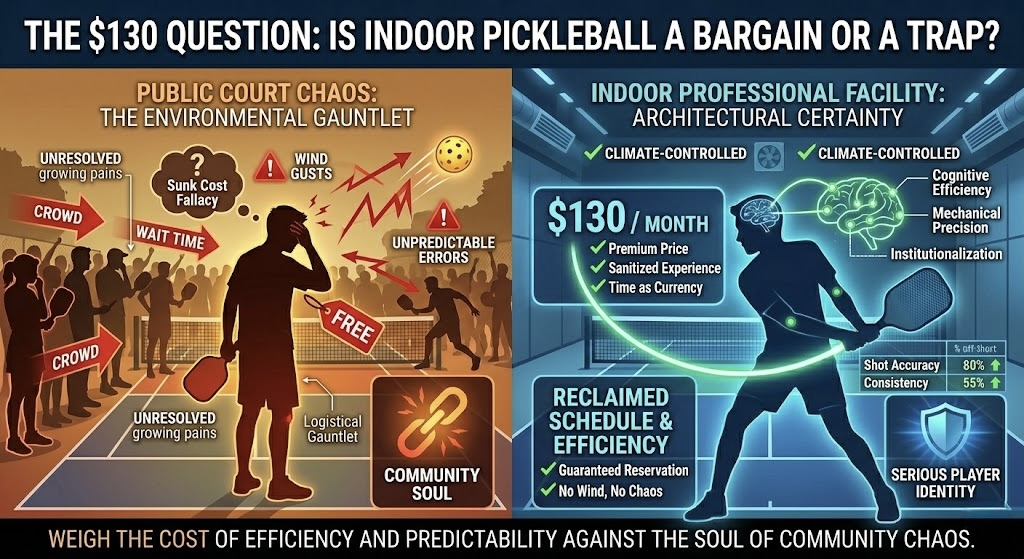
For the seasoned athlete, the charm of the public pickleball court is beginning to wear thin. What was once a democratic explosion of community spirit has, in many zip codes, devolved into a logistical gauntlet. We have all been there: standing on the asphalt perimeter, paddle in hand, tracking the erratic dance of a plastic ball caught in a crosswind while eyeing a crowded sideline that suggests our next twenty minutes of "play" will be spent mostly standing still.
This friction has birthed a new industry of professional indoor facilities—temples of climate-controlled consistency that promise to solve the sport’s growing pains. But as these venues move from novelty to necessity, they bring a sophisticated tension to the game. We are witnessing the institutionalization of pickleball, where the core conflict is no longer about finding a partner, but about whether we are willing to pay for a curated escape from the elements.
Takeaway 1: The Premium Price of Playing it Cool
The price of this sanctuary has crystallized at a specific, non-trivial threshold: $130 per month. To the casual observer, this may seem like a simple membership fee; to the lifestyle veteran, it represents a significant premium barrier to entry. For a sport that built its massive following on the back of free public parks and accessible recreation, a triple-digit monthly commitment is more than a cost—it is a cultural pivot.
This $130 price point positions indoor pickleball alongside boutique fitness studios and high-end athletic clubs. It forces a calculated evaluation of the game’s role in one’s life. When the barrier to entry moves from "free" to "financial gatekeeping," the sport shifts from a spontaneous hobby to a serious line item in a household budget.
"Decide if the convenience is actually a bargain or just a new fitness trap."
Takeaway 2: The Hidden Enemies of the Game—Wind and Crowds
The flight to indoor facilities is driven by a desire for architectural and environmental certainty.
- Environmental Erasure: Indoor play eliminates the wind, the ultimate equalizer and agitator of the outdoor game. In a controlled environment, skill is no longer subject to the whims of a sudden gust.
- The Sanitized Experience: Crowds at public sites have become a deterrent. Players are increasingly willing to pay for the privilege of a guaranteed reservation.
- Time as Currency: The modern player views the avoidance of long wait times not just as a convenience, but as a reclaiming of their personal schedule.
- Consistency over Chaos: Professional facilities offer a "true" game where the variables are limited to the players themselves, removing the grit and unpredictability of the park.
Takeaway 3: Avoiding the "Fitness Trap"
As a columnist who has watched the rise and fall of various fitness "revolutions," I see the $130 fee as a psychological catalyst. This is where we encounter the "fitness trap"—a phenomenon rooted deeply in the Sunk Cost Fallacy. When you commit to a high-priced membership, your relationship with the sport fundamentally changes. You are no longer just a participant; you are a customer seeking a Return on Investment.
This creates an invisible pressure. Each missed session feels like a financial loss, potentially turning a joyful pastime into a recurring obligation. Professional facilities are betting on this psychological tether. They understand that by providing a controlled, high-quality environment, they are selling you an identity: the "serious" player who values efficiency over the messy, community-driven nature of public play. The trap isn't just the cost; it's the shift in mindset that demands every hour on the court be "worth it" in dollars and cents.
Closing Reflection: The Future of the Court
The commercialization of pickleball is likely inevitable, a symptom of its own staggering success. As the sport migrates from the public square into these streamlined, professional enclosures, we must weigh what is being gained against what is being left behind on the sidewalk. We are buying predictability, yes, but we are also buying our way out of the very chaos that gave the sport its soul.
This evolution brings us to a final, provocative crossroads in our fitness journeys. At $130 a month, are you buying a better game, or are you just paying to stay isolated from the community that built the sport in the first place?

Why Your Favorite Hobby Is Actually Making You Worse: The Case for Targeted Drills