Why Your Favorite Hobby Is Actually Making You Worse: The Case for Targeted Drills
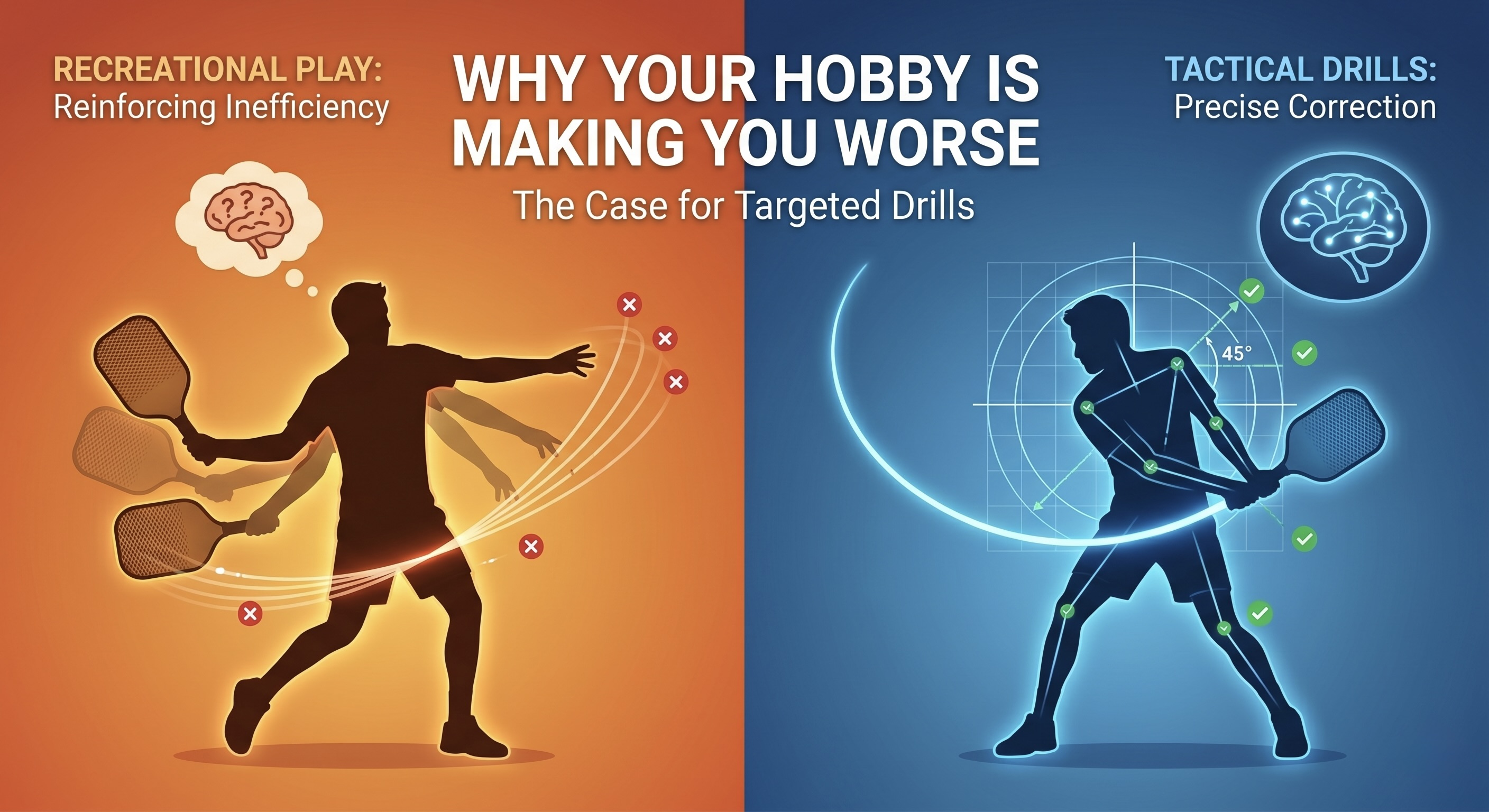
Many athletes fall into the trap of the "Plateau Paradox": the frustrating state where increased effort no longer yields performance gains. You are playing harder, logging more hours, and yet your progress has flatlined. This occurs because the brain is an efficiency machine that does not distinguish between a high-performance movement and a biomechanical deviation; it simply myelination the neural pathways of the actions you repeat most often. If your volume is high but your form is flawed, you aren't getting better—you are simply becoming more expert at being mediocre.
The secret to breaking this cycle and achieving rapid athletic growth isn't more playtime, but significantly less.
How Recreational Play Reinforces Limiting Habits
When engagement is purely recreational and unmonitored, it becomes neurologically counter-productive. In the heat of a casual game, the primary objective is the immediate outcome—winning the point or finishing the set—which causes the athlete to rely on "comfort zone" mechanics. These often involve mechanical inefficiencies that go unnoticed in the chaos of play. Without a structured, immediate feedback loop, these deviations are repeated until they are hard-coded into your physiology.
It is a common misconception that "practice makes perfect." In the world of high-level skill acquisition, we know that practice actually "makes permanent." By indulging in unguided, casual play, you are effectively reinforcing the very technical errors that keep you tethered to your current plateau. Unmonitored repetition is not a path to excellence; it is a mechanism for cementing bad habits.
"Casual play reinforces bad habits while limited, focused drills unlock rapid athletic growth."
The Transformative Power of Tactical Drilling
To catalyze rapid growth, an athlete must shift from broad, high-volume activity to limited, focused drills. This "less is more" approach works because reducing total volume allows for a massive increase in cognitive intensity and mechanical precision. By isolating a single component of a movement—such as a specific joint angle or a timing trigger—you can apply high-repetition correction that is impossible during the multi-variable environment of a full game.
This shift requires a commitment to "data-backed training." True improvement is not felt; it is measured. Instead of relying on general effort, tactical drilling utilizes specific metrics to diagnose and solve performance bottlenecks. By tracking objective data, you move away from the "intuition-based" plateau and toward a trajectory of measurable mastery.
A Comparison of Training Frameworks:
- Recreational Play: General and vague; focused on immediate outcomes; delayed or absent feedback loops.
- Tactical Drills: Specific and measurable; focused on mechanical precision; immediate, objective feedback loops.
- Data Metrics: Captured via shot accuracy percentages, time-to-completion, or heart-rate variability (HRV) during execution to ensure physiological readiness.
Shifting Mindset Toward Tactical Mastery
Transitioning from a recreational mindset to one of tactical mastery requires the discipline to prioritize process over play. This shift is not a rejection of the joy of the sport; rather, it is an evolution toward a deeper, more sustainable form of fulfillment. Mastery provides a level of competence and fluid control that casual play can never offer. It is the difference between "getting through" a game and "dominating" it through refined execution.
By stepping away from the game environment to focus on the underlying mechanics, you "unlock" potential that has been suppressed by years of unmonitored play. When you replace the chaos of recreation with the precision of tactical mastery, you stop fighting against your own habits and start leveraging your training to achieve peak performance.
A New Strategy for Growth
To reach the next level of performance, you must be willing to stop "playing" and start "drilling." By replacing unmonitored recreation with focused, data-backed exercises, you convert stagnant habits into rapid athletic growth. True mastery is not found in the volume of the game, but in the precision of the drill and the intentionality of the rep.
The Final Thought: Are your current training habits actually refining your skills, or are they simply making your mechanical inefficiencies more permanent?

7 Counter-Intuitive Pickleball Secrets to Level Up Your Game (Without Getting Smashed)


