Why Your Pickleball Game Might Be a Trip to the ER: The Surprising Rise of Court Injuries
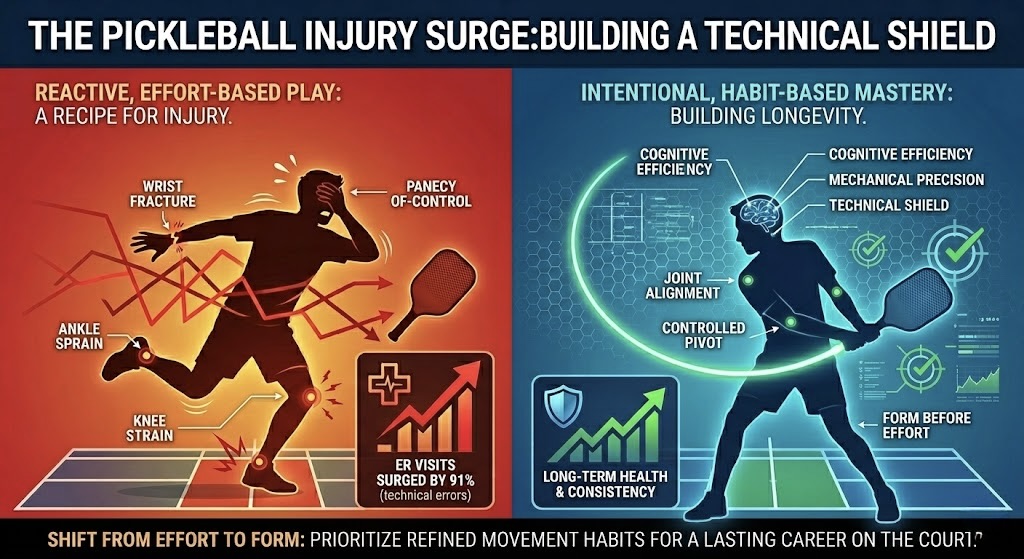
Pickleball is the social phenomenon of the decade, celebrated for its accessibility and high energy. However, as a specialist focused on athlete longevity, I am seeing a disturbing trend beneath the surface of the fun. The court has become a high-risk environment where the physical toll is mounting at an alarming rate. We must address why a game that looks so friendly is sending an unprecedented number of players to the hospital.
The 91 Percent Surge: A Reality Check
The popularity of the sport has created a massive influx of participants, but this growth has come with a sobering cost. The data suggests that the surge in players has significantly outpaced their physical preparation for the game's demands.
"Emergency room visits for pickleball injuries have surged by 91 percent, often driven by common technical errors."
This statistic is a wake-up call for the entire community. It highlights a critical gap between the desire to play and the technical proficiency required to stay safe. When the intensity of competition exceeds a player’s preparation, the results are increasingly found in the emergency room rather than on the scoreboard.
The Technical Trap: Why Form Matters More Than Effort
Injuries are not merely the result of bad luck or "part of the game." They are fundamentally driven by technical errors that compromise the body's integrity.
Many players fall into the trap of "sacrificing the body" for the sake of the game. They believe that sheer effort can compensate for a lack of proper technique.
Effort without form is a recipe for disaster. When you prioritize winning a point over maintaining correct mechanics, you are choosing a short-term win over long-term health.
The Solution: Mastering Movement Habits
The path to staying on the court and out of the hospital requires a fundamental shift in mindset. You must stop sacrificing your body for the game and start mastering simple movement habits.
The key to longevity is moving from a reactive state to a state of intentional mastery. This means prioritizing the habit of "moving correctly" over the impulse of "winning the point."
While these habits are simple, they require consistent focus to master. By refining how you navigate the court, you create a technical shield that protects you from the common errors currently driving the injury surge.
Conclusion: Play for the Long Game
Pickleball should be a game played for years, not a sprint that ends in a medical emergency. To ensure your career on the court lasts, you must prioritize your physical health over short-term competitive gains. Technical proficiency is your greatest asset—not just for your skill level, but for your safety.
Before you next step onto the court, ask yourself: Are your movement habits protecting your body, or are you one technical error away from the emergency room?

7 Counter-Intuitive Pickleball Secrets to Level Up Your Game (Without Getting Smashed)


