The Dead Zone: Why Your Court Positioning Is Killing Your Game
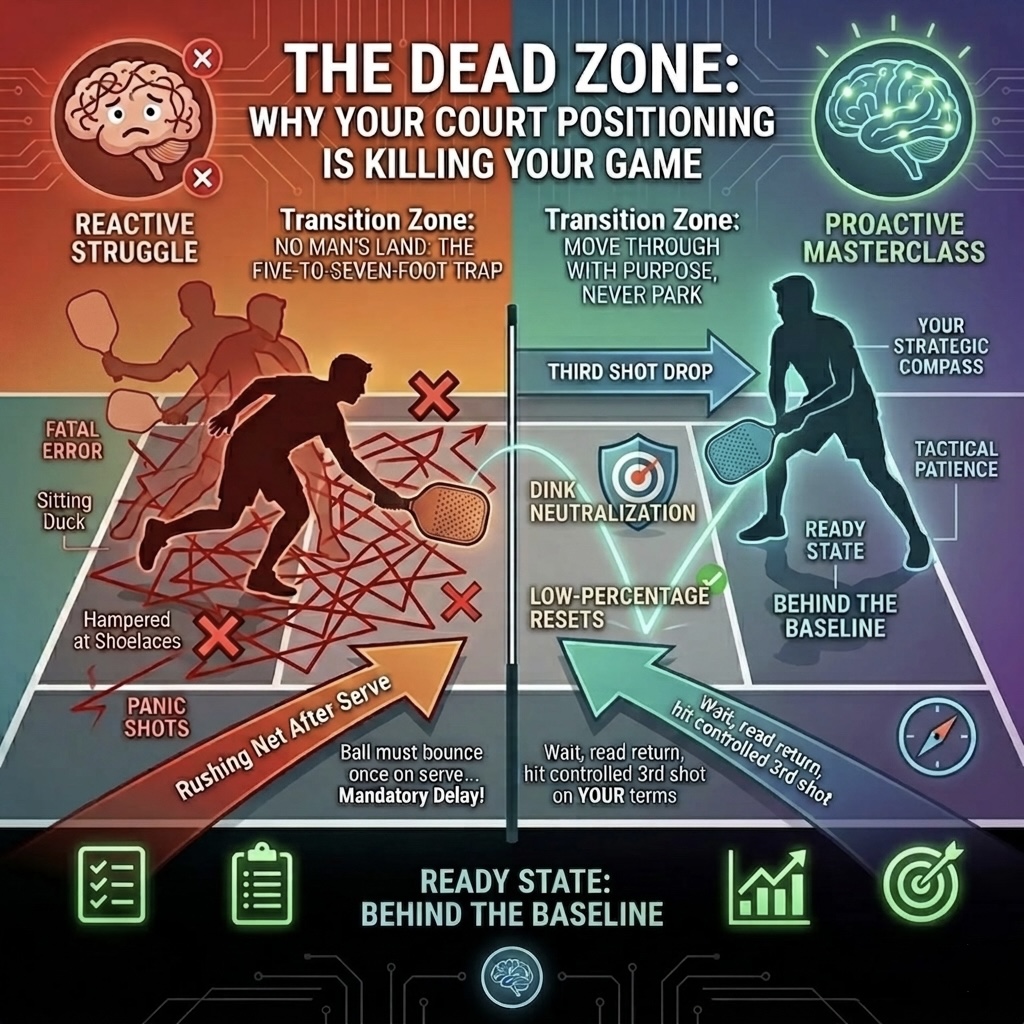
1. Introduction: The Invisible Trap
You’re fast, you’re lean, and you’ve got a backhand that should be illegal. So why are you getting dismantled by a duo half your speed? For many high-energy players, the source of this frustration isn’t a lack of talent—it’s a lack of spatial intelligence. In pickleball, your athleticism actually backfires when it’s applied to the wrong part of the court.
You are likely falling victim to the transition zone, an invisible trap more appropriately known as "No Man’s Land." This area is a graveyard for potential wins, where even the most gifted athletes find themselves short-circuiting their own points. If you want to stop the bleeding, you need to master the two-bounce rule, a strategic compass that dictates exactly where you belong on the court and why your current instincts are leading you into an ambush.
2. The "No Man's Land" Trap: Why Standing Still is a Fatal Error
In the geometry of a pickleball court, the transition zone is the vast, vulnerable space between the baseline and the Non-Volley Zone (the Kitchen line). Specifically, it’s that five-to-seven-foot stretch where you are neither safely anchored at the back nor dominant at the net.
The fatal error isn’t passing through this zone—it’s treating it like a destination. When you stand still in No Man's Land, you are a sitting duck. Balls will be hammered at your shoelaces, forcing you to hit "panic" shots from your feet while your opponents move in for the kill. To stay competitive, you must treat this area like a high-speed lane: you move through it with purpose, but you never park there.
"No Man's Land: Escaping the Transition Zone Trap."
3. The Two-Bounce Rule: Your New Strategic Compass
To navigate the court like a pro, you must first respect the two-bounce rule (also known as the Double Bounce Rule). This isn't just a suggestion; it is the fundamental law of the game. It dictates that the ball must bounce once on the serve and once on the return before any player can legally hit a volley (a ball out of the air).
This rule is the primary reason why court positioning is so counter-intuitive for beginners. New players often feel a frantic urge to charge the net immediately to seize control of the point. However, the two-bounce rule creates a mandatory delay. If you rush forward before the ball has bounced twice, you are effectively abandoning the only legal way to play the point. Mastering this rule requires tactical patience—staying back until the "two-bounce" requirement is met is the only way to escape the "No Man's Land" trap.
4. The Fatal Error: Stop Rushing the Net After the Serve
Do not rush the net immediately after you serve. This is the single most common unforced tactical error in the game, and it’s a rookie mistake that even intermediate players make out of habit.
When you serve and immediately sprint toward the Kitchen, you are begging for a loss. Because of the two-bounce rule, the serving team must let the return of serve bounce before they can hit it. If you have already charged into the transition zone or reached the net, the opponent’s return will land at your feet or hit you before it bounces. This results in an immediate fault or a weak, defensive pop-up that your opponent will smash.
Waiting is actually the fastest way to gain a competitive advantage. By staying behind the baseline after your serve, you give yourself the space to read the return and hit a controlled third shot. This allows you to advance to the net on yourterms, rather than sprinting into a disadvantageous position where you are physically unable to play the ball legally or effectively.
5. Conclusion: Reclaiming the Court
Mastering court positioning transforms your game from a reactive struggle into a proactive masterclass. When you stop getting stuck in the transition zone and start respecting the mechanical reality of the two-bounce rule, you take away your opponent's greatest weapon: your own poor positioning. You stop being the victim of the court and start becoming its architect.
As you head into your next match, take a hard look at your footwork: Are you moving with a strategic purpose, or are you handing your opponent the match by standing in the dead zone?

7 Counter-Intuitive Pickleball Secrets to Level Up Your Game (Without Getting Smashed)


