The Geometry of Winning: Why Your Pickleball Paddle Shape is Quietly Ruining Your Game
1. The Kitchen Line Split-Second
Picture yourself at the kitchen line. It is match point, and the tension is palpable. Your opponent winds up for a speed-up, firing a hard drive directly at your chest. In that visceral split second, your gear makes the decision for you. If you are wielding a long, narrow blade, you might find yourself "handcuffed," your reaction punctuated by a dull thud as the ball catches the edge—you simply couldn't get the head around in time. Conversely, a wider, squarer paddle might have provided the hand speed to meet the ball with a crisp snap, neutralizing the attack instantly.
Now, reverse the scenario: a high lob sails over your left shoulder. That square paddle whiffs, coming up a crucial inch short. The long blade, however, snags it out of the air for a cross-court winner. We often view paddles as mere hitting surfaces, but the geometry of your equipment dictates your entire court strategy. Most players choose paddles based on professional endorsements, yet a mere half-inch of carbon fiber is the difference between a controlled reset and a game-ending pop-up.
2. It’s Not the Weight, It’s the Swing: The Hammer Principle
To master the game, you must look past the static weight on the box and understand "swing weight." While two paddles might both weigh 8.0 ounces on a scale, their distribution of mass creates entirely different physical realities once they become a lever arm in your hand.
Think of it like a hammer. If you hold a hammer by the handle, the weight is far from the fulcrum (your wrist), making it feel heavy and difficult to accelerate. If you grab the hammer by the metal head, it feels weightless, allowing for instant flicking motions.
An elongated paddle like the Joola Perseus (16.5” long, 7.5” wide) is the hammer held by the handle. The mass is distributed further from your hand, creating high swing weight and immense "plow-through"—where the paddle wins the collision against a hard-hitting ball. A widebody paddle like the Joola Scorpius (16” long, 8” wide) is the hammer held near the head. By moving that half-inch of length into the width, the mass centers closer to the hand, prioritizing acceleration over raw force.
"Physics is stubborn. You usually have to trade one for the other. The Perseus offers plow-through; the Scorpius offers the ability to change directions instantly."
3. Sword vs. Shield: Choosing Your Warfare Philosophy
In the biomechanical world, paddle shapes represent two distinct archetypes of warfare. Choosing the wrong one is like bringing a rapier to a phalanx formation.
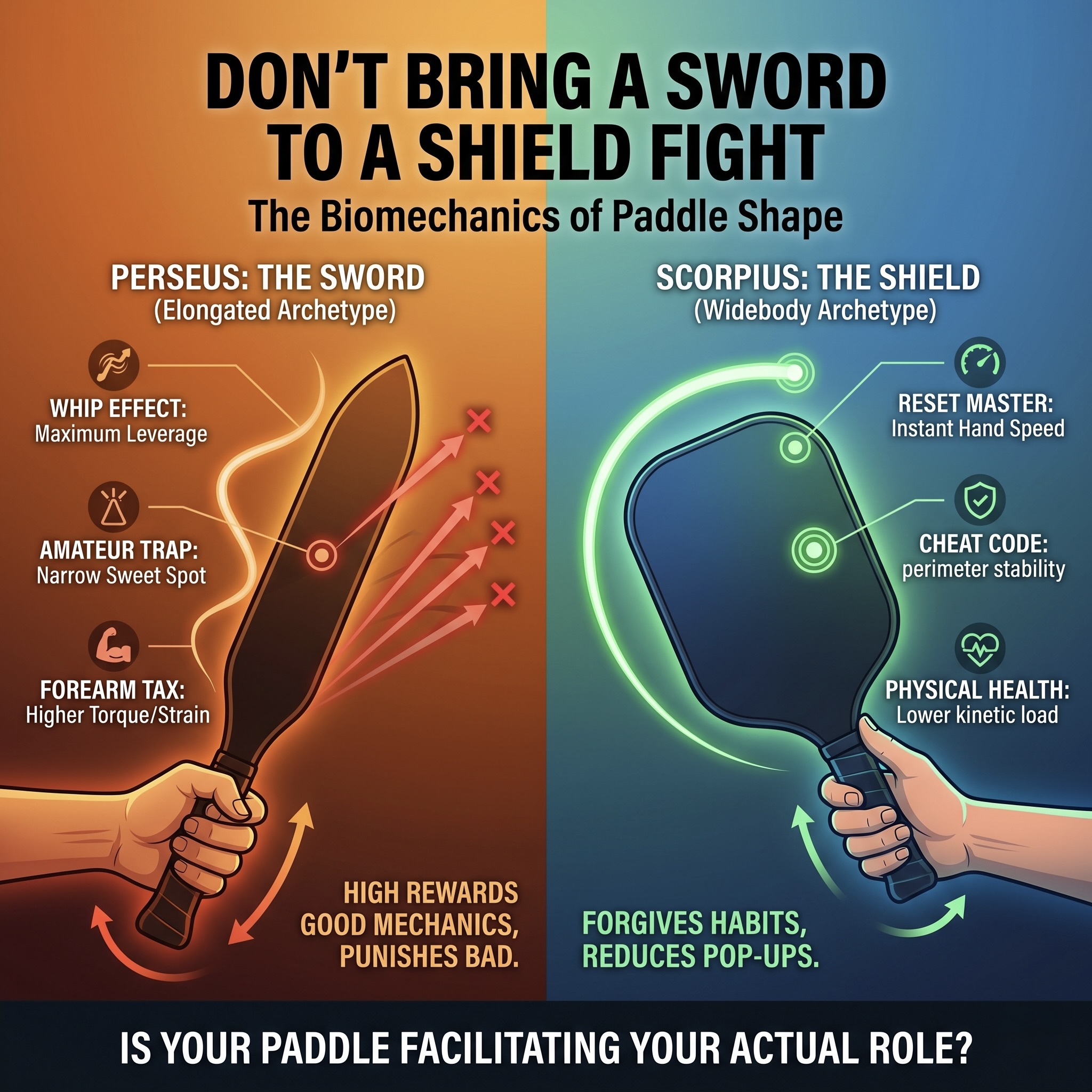
- The Sword (Elongated Archetype): This is the tool of the offensive aggressor. The 16.5-inch length provides maximum leverage. Because the tip moves significantly faster than the handle—a phenomenon known as the "whip effect"—it is dominant for baseline drives. On full-speed swings, centrifugal force naturally pulls the ball toward the tip of the paddle, where the Perseus’s sweet spot is strategically located to reward big hitters.
- The Shield (Widebody Archetype): This is the tool of stability and the "reset" master. By widening the face to 8 inches, this shape excels at hand speed. It is designed to neutralize pace rather than generate it, making it the premier choice for the defensive specialist.
The Sword’s "whip effect" comes with a hand-speed tax. Once that long lever arm starts moving, its momentum is difficult to arrest. In a rapid-fire volley exchange, the Sword requires significantly more forearm strength to stop, reverse, and redirect than the Shield.
4. The Amateur Trap: The Hidden Cost of the Narrow Sweet Spot
The most dangerous metric for the average player is "twist weight"—the paddle’s resistance to rotating sideways during an off-center hit. A wider paddle like the Scorpius places more mass at the perimeter, farther from the center axis. It functions like a tightrope walker holding a long pole; the width creates a physical counterbalance that prevents the paddle from wobbling.
Many 3.5-level players fall into the "Amateur Trap," buying elongated paddles for the "power" label despite lacking the precise footwork required to find a narrow sweet spot. On a 7.5-inch wide paddle, a mishit near the edge guard causes the face to twist, dumping the ball into the net. The Scorpius, however, is a "cheat code" for stability. It allows for "sloppy" contact, absorbing energy and sending the ball back over the net even when your mechanics fail.
"The Scorpius forgives bad habits, while the Perseus rewards good ones but punishes the bad. For most, the path to 4.0 isn't more power—it's fewer pop-ups."
5. The Forearm Tax: Geometry and Your Physical Health
From a biomechanical perspective, your paddle shape is a health decision. High swing weight creates simple, brutal torque. The further the center of mass sits from your wrist, the more strain is placed on the extensor muscles of the forearm to stabilize the unit.
This "Forearm Tax" is paid most heavily during backhand flicks and late blocks. When you are forced to react to a ball behind your body’s midline, the elongated paddle acts as a massive lever against your elbow joint. If you have a history of tennis elbow or find your reflexes slowing with age, the leverage of the Sword is a high-risk liability. The Shield, with its mass centered closer to the hand, significantly reduces the load on the kinetic chain.
6. Biomechanics and the Two-Handed Reality
The geometry of the handle is often the final, overlooked piece of the biomechanical puzzle.
- The Perseus (Elongated): Features a 5.5-inch handle, the gold standard for players coming from a tennis background who utilize a two-handed backhand. It provides the "runway" needed for the top hand to drive through the ball.
- The Scorpius (Widebody): To stay within legal limits, the handle is often shortened to 5.25 inches.
For players with large hands or those who rely on a "wristy," table-tennis-style flick, the Scorpius is a dream. However, if you have a large physical frame, you may find your bottom hand slipping off the pommel of a widebody, cramping your stroke and ruins your stability.
7. Conclusion: Don’t Bring a Sword to a Shield Fight
Pickleball's governing rules are clear: the combined length and width of a paddle cannot exceed 24 inches (L + W \leq 24). This creates a zero-sum game. Every half-inch you add to length to gain reach must be sacrificed from the width, costing you stability.
If you are a tennis convert with a high-speed swing and a two-handed backhand, the Perseus is your Sword. But if you are a recreational player looking to bridge the gap from 3.5 to 4.0, your fastest route is through the "Shield." You don't need to hit the ball harder; you need to stop popping it up. The widebody shape is the ultimate tool for keeping the ball down and staying in the point long enough for your opponent to make the mistake.
Before your next session, audit your bag: Is your paddle facilitating your actual role on the court, or are you just carrying a sword into a shield fight?

Why Your Favorite Hobby Is Actually Making You Worse: The Case for Targeted Drills