Why April is the Most Important Month in American Sports: The Rise of National Pickleball Month
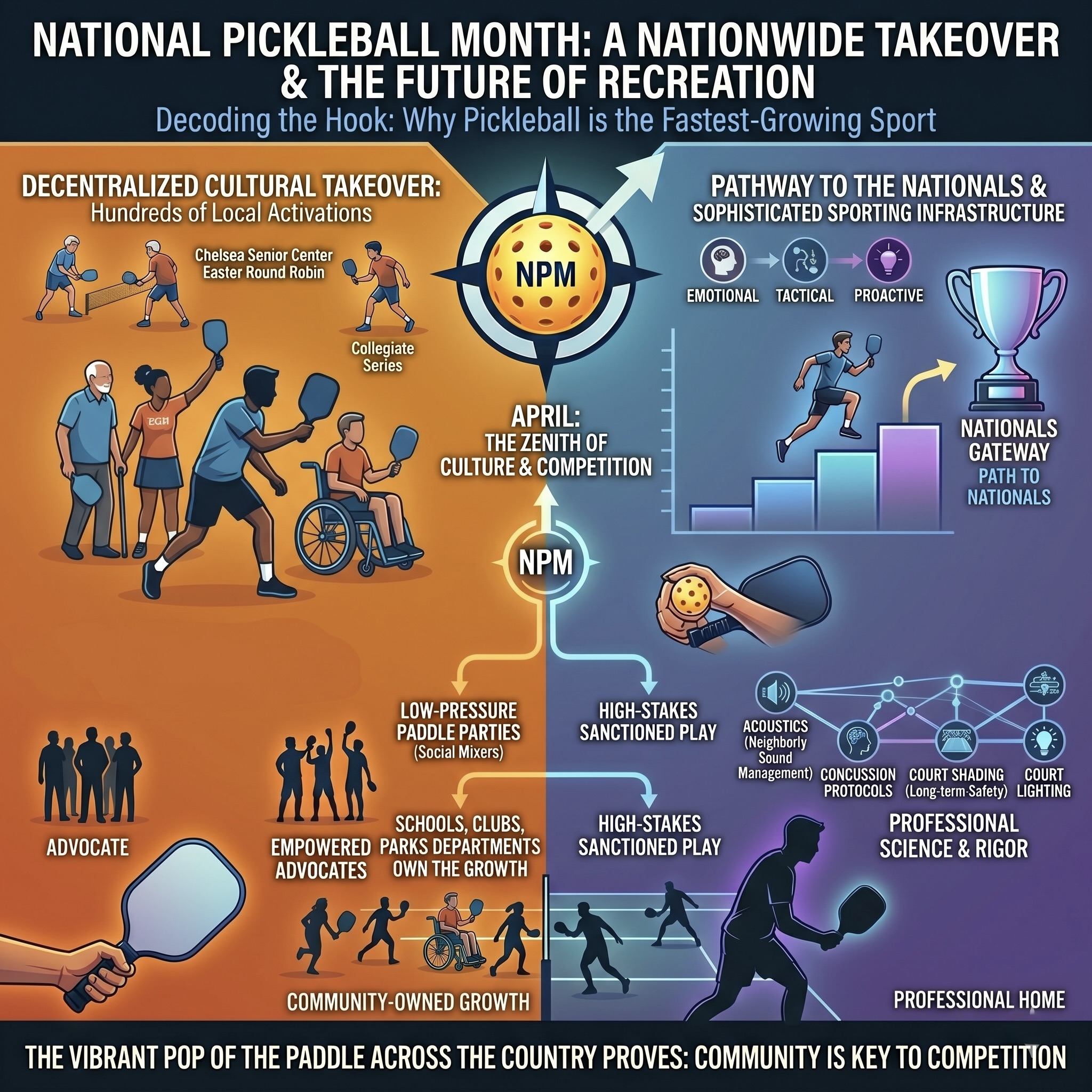
The Hook: A Quiet Revolution on the Court
It has been called the "fastest-growing sport in America," but to describe pickleball as merely a trend is to miss the larger cultural shift. What began as a backyard curiosity has evolved into a full-scale movement that reaches its zenith every April. This isn’t just a window on the calendar; it is National Pickleball Month (NPM), a time when the rhythmic "pop" of the paddle orchestrates the life of neighborhoods from coast to coast.
During this month, the sport’s visibility surges as USA Pickleball transforms the landscape into a coordinated, nationwide celebration. The month serves as a collective invitation, lowering the barrier to entry while signaling the sport's arrival as a permanent fixture of the American lifestyle.
But why has a game famously played in a space called "the kitchen" managed to command such a significant presence in the sporting world? The answer lies in how the sport has organized itself to be more than just a game, turning an entire month into a sophisticated showcase of community and competition.
Takeaway 1: It’s Not Just a Month, It’s a Nationwide "Takeover"
The scale of National Pickleball Month is a Decentralized Cultural Takeover.
Instead of a single, centralized tournament, NPM manifests as hundreds of local activations across the American geography.
In early April, "The Beal Deal" kicks off a calendar that looks more like a dense tapestry than a simple schedule.
At Maine Pines Tennis and Fitness, advanced groups gather for high-intensity play, while players at the Rio Grande Winery engage in social Round Robins.
The energy moves through "MEGA Fiestas" and "Paddle Parties" at venues like The Picklr in Danvers or Center Court.
In Kansas, the "Queen of Courts" in Wichita empowers female athletes, while "Pickleball 101" sessions in DC welcome the uninitiated.
This geographic density reflects a movement that is highly organized yet locally driven, ensuring the court is always within reach.
Takeaway 2: Radical Inclusivity is the Secret Sauce
The defining characteristic of this movement is the philosophy of Radical Human Inclusivity. Unlike traditional sports that often segregate players by rigid demographics, National Pickleball Month purposefully blurs the lines between ages and abilities.
The 2026 schedule highlights this beautifully: the high-octane energy of the Collegiate Series exists alongside the "Chelsea Senior Center Easter Round Robin." This multi-generational appeal is reinforced by the sport’s integration of Adaptive and Wheelchair Rules, ensuring that the "Open Play" invitation is literal. This isn't just about playing a game; it's about building a unique social fabric where juniors and seniors share the same architectural space.
"The 2025 National Pickleball Month initiative highlighted the best of pickleball, its inclusive spirit, and encouraged players of all ages and skill levels to join in the fun, proving that Pickleball is For All!"
Takeaway 3: The "Golden Ticket" to the Big Leagues
While many April events focus on social mixers, there is a serious competitive engine fueling the sport's professional aspirations. April serves as a critical gateway through Pathway to the Nationals tournaments. Known as "Golden Ticket" events, these sanctioned competitions are the primary route for athletes to earn their spot at the USA Pickleball Nationals.
This creates a fascinating juxtaposition. On one court, you might find a "Covina Picklers Clinic" designed for beginners; on the next, elite athletes are navigating the Tiered Point System (TPS) and official player rankings. By offering both low-pressure "Paddle Parties" and high-stakes sanctioned play, the sport successfully satisfies both the casual hobbyist and the dedicated professional.
Takeaway 4: A Sport Built by "Ambassadors," Not Just Athletes
Pickleball’s expansion is driven by a User-Owned Growth Model. Unlike sports that rely on billionaire owners and top-down marketing, USA Pickleball empowers the "average" player to become a community leader through its Ambassador program.
The organization provides "NPM Assets" and toolkits that allow schools, clubs, and parks and recreation departments to host their own sanctioned events. This "open source" approach to sports marketing allows the community to own the growth of the game. It effectively turns players into advocates, making the sport's expansion faster and more resilient than traditional marketing ever could.
Takeaway 5: The Surprising Science of the Game
As the sport matures, it is demanding the Sophisticated Sporting Infrastructure of a professional league. National Pickleball Month highlights that the game has moved past its "hobby" phase. USA Pickleball now provides technical resources on "Acoustics" to manage sound in residential areas—essentially teaching the sport how to live with its neighbors as it expands.
From "Concussion Protocols" to the engineering of "Court Shading" and "Pickleball Court Lighting," the sport is investing in long-term safety and architectural rigor. This attention to detail, from the physics of approved equipment to the safety of the players, proves that pickleball is building a permanent, professional home in the American sports landscape.
Closing: The Future of the Kitchen
National Pickleball Month is more than a collection of clinics and social mixers; it is a preview of the future of American recreation. By prioritizing inclusivity and empowering local leaders, the sport has created a model that values social connection as highly as athletic achievement.
As the courts continue to multiply and the communities grow, are we witnessing the birth of a new American pastime that finally puts community above competition? The vibrant "pop" of the paddle across the country this April suggests the answer is a resounding yes.

7 Counter-Intuitive Pickleball Secrets to Level Up Your Game (Without Getting Smashed)


