Why the Best Offense is a Narrower Court: Mastering the "Funneling" Strategy
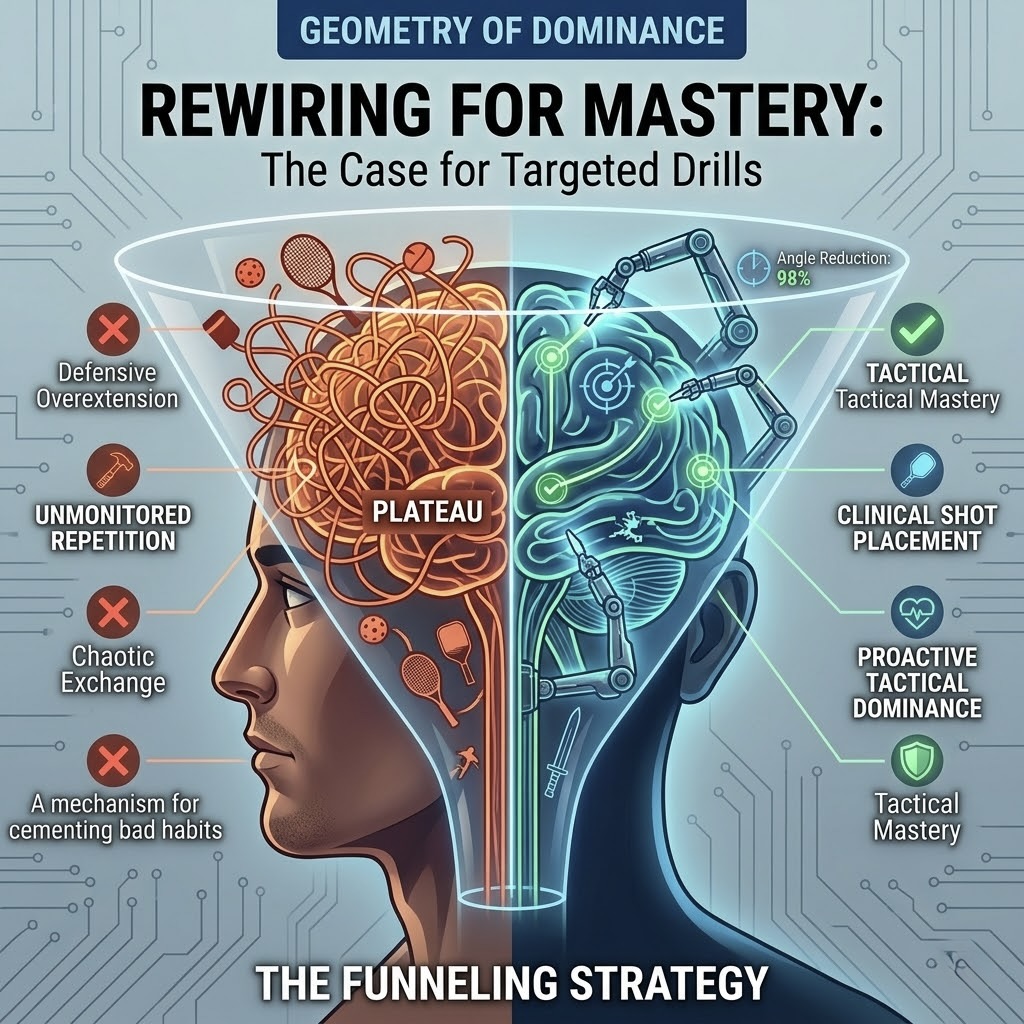
The Hook: The Geometry of Dominance
In the arena of high-performance athletics, victory is rarely the result of maximum exertion; it is the product of superior spatial optimization. Most competitors succumb to the exhaustion of defensive overextension, frantically attempting to cover every square inch of the court against a mobile adversary. They view the court as a vast, open territory to be defended, rather than a geometric grid to be manipulated.
The "Funneling Strategy" represents a paradigm shift from reactive athleticism to proactive tactical dominance. It is a sophisticated method designed to seize control of the point by systematically contracting the opponent's options. By utilizing clinical shot placement, you can stop defending the whole court and start forcing your opponent into a narrow, predictable corridor of failure.
Takeaway 1: Shrink the World—The Power of Angle Reduction
The essence of funneling is the deliberate reduction of the opponent’s spectrum of return possibilities. When a player strikes a ball into the "safe" middle of the court, they inadvertently provide their opponent with the maximum possible angles for a counter-attack. Conversely, by compressing the field of play toward specific tactical zones, you effectively "close" large sections of the court.
This creates a psychological and tactical bottleneck. While raw power aims to blow past an opponent, angle reduction aims to paralyze their decision-making. As the available court "shrinks," the opponent transitions from a state of creative play to one of survival. They are no longer choosing their best shot; they are forced into the only shot that remains viable within the restricted geometry you have provided. This spatial constraint ensures that the flow of the point is no longer a chaotic exchange, but a controlled descent into a predictable outcome.
Takeaway 2: Aiming for the Edge—The Low-Percentage Paradox
To initiate this structural collapse of the opponent’s defense, a strategist must employ what are traditionally termed "low-percentage shots to the outside edges." In conventional play, targeting the extreme sidelines is often dismissed as a high-risk error. However, within the funneling framework, these shots are calculated tactical gambles designed to shift the court's gravity.
The "paradox" lies in the risk-to-reward ratio: while the individual shot carries a higher risk of landing out, the successful execution of an edge-shot forces the opponent into a position of total mechanical vulnerability. As the source context emphasizes:
"A deep dive into the 'funneling' technique. Master the low-percentage shots to the outside edges that isolate one player and shrink the available court angles."
By drawing the opponent to the periphery, you disrupt their equilibrium and strip away their ability to reset the point to a neutral state. You aren't just hitting a ball; you are moving a chess piece into a corner from which there is no escape.
Takeaway 3: The Art of Isolation
The primary objective of edge-targeting is the clinical isolation of a single player. In a competitive environment, rhythm is a defensive tool; isolation destroys it. By funneling the play into a specific quadrant, you force a single individual to shoulder the entire burden of the rally, effectively removing their partner's influence in doubles or their own recovery time in singles.
This isolation creates a "2-on-1" mental dynamic. The isolated player becomes hyper-aware of their shrinking options, leading to physical fatigue and a breakdown in technical execution. The flow of the point is transformed from a balanced encounter into a lopsided struggle where the opponent is trapped in a bottleneck. They become a spectator to their own defeat, unable to rotate or reset as you continue to hammer the same tactical weakness.
Takeaway 4: Winning with Constraint
Winning the Point With Just Backhands
The pinnacle of funneling is the realization that limiting an opponent's options is exponentially more lethal than expanding your own. The ultimate goal is to force the play into a single, predictable shot type: the backhand. By utilizing the outside edges to pull an opponent wide, you exploit the natural biomechanical limitations of the backhand wing.
When you manipulate the geometry so that the only safe return is a cross-court backhand, you have achieved total predictability. You are no longer guessing where the ball will go; you are waiting for it. This level of constraint allows the strategist to maintain a high-performance "ready state," knowing exactly which technical weakness the opponent must reveal. You win the point not by hitting a winner, but by ensuring the opponent has no other choice but to lose.
Conclusion: The Strategic Mindset
Mastering the funneling technique transforms a player from a physical competitor into a clinical performance strategist. It requires a shift in focus from "how hard can I hit?" to "how much of the court can I eliminate?" When you stop trying to win the whole court and start focusing on the bottleneck, the game becomes a series of high-probability outcomes rather than a chaotic struggle.
In your next match, evaluate your shot selection: are you providing your opponent with a wide-open world of possibilities, or are you brave enough to make their world much, much smaller?

7 Counter-Intuitive Pickleball Secrets to Level Up Your Game (Without Getting Smashed)


